In 2026, the MRI industry is facing a reality that analysts call “Helium Shortage 4.0.” Liquid helium has ceased to be a mere technical gas. It is now a strategic asset—”blue gold”—whose price is soaring while its availability plummets.
For the owner of a GE Healthcare Signa MRI scanner, this means one thing: any error in maintaining your cooling system now costs three times more than it did just five years ago.
Why the Deficit? The Root Causes of the Crisis
To understand why refilling a magnet has become a major challenge, one must look at the global resource map:
- Exhaustion of the “World Reserve”: For decades, the market was buffered by the U.S. Federal Helium Reserve (Cliffside). It stabilized prices by releasing stocks during shortages. By 2025–2026, this reserve was almost entirely depleted and privatized. The “safety net” no longer exists.
- The Complexity of “By-product” Extraction: Helium is not mined from dedicated wells. It is a byproduct of natural gas extraction (with concentrations as low as 0.1%–0.5%). Any fluctuations in the gas market or the closure of aging fields in Algeria, Qatar, or the USA immediately disrupt helium supply chains.
- Competition with Tech Giants: Healthcare is no longer the priority consumer. Manufacturers of semiconductors for AI, fiber optics, and aerospace companies (such as SpaceX and Blue Origin) purchase helium in massive quantities. A clinic with a single tomograph is now competing for resources against microchip mega-factories.
- The Logistics Deadlock: Liquid helium has a limited “shelf life” in Dewar flasks. The complication of global trade routes has extended delivery times. Every extra day in transit means the evaporation of gas that you have already paid for.
Quench as a Financial Catastrophe
In the past, a quench (the emergency discharge of helium) was a painful but predictable incident. In 2026, it is a catastrophe:
- Restoration Cost: Amidst the shortage, the cost of a full magnet refill (~1,000–1,500 liters) is comparable to the annual profit of a small diagnostic center.
- Downtime Risks: You cannot simply buy helium “tomorrow.” In a deficit, supplies are allocated by quotas. The wait time for a refill can stretch into weeks, during which the clinic remains idle, losing both patients and reputation.
Magmon and Cryowatch: Your “Safe” for Helium
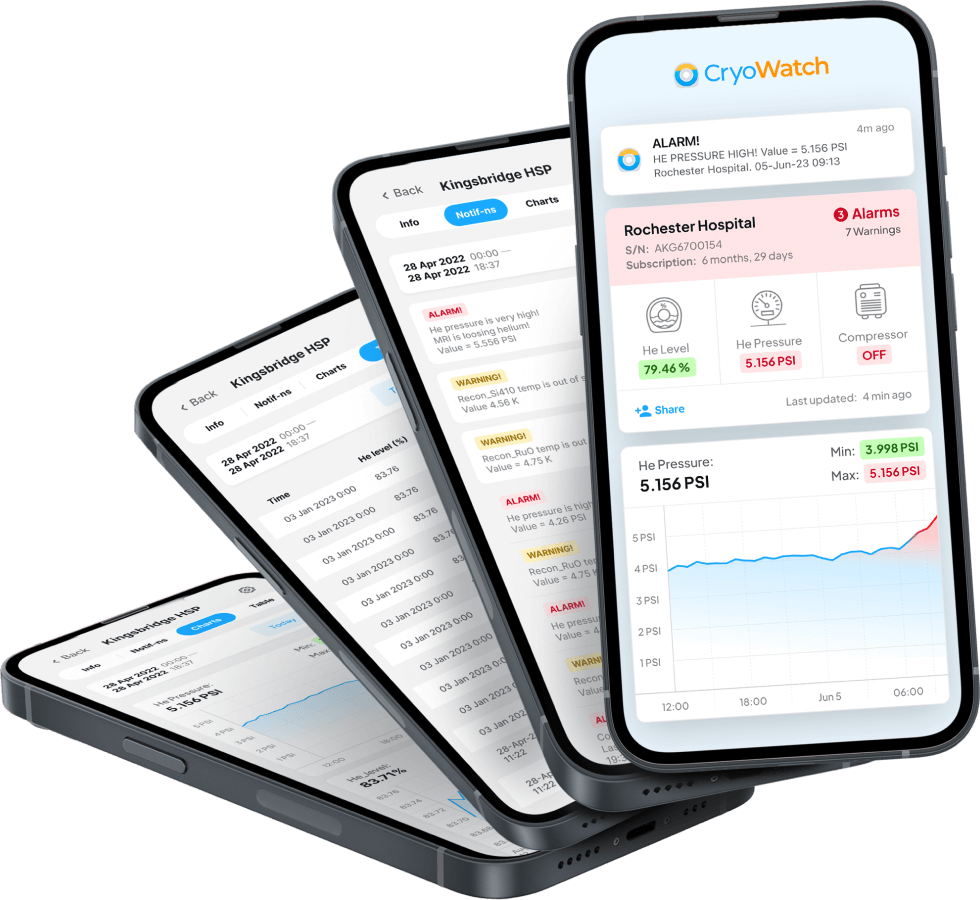
In today’s environment, the Magmon unit and the Cryowatch system are more than just sensors. They are your security service, guarding every liter inside the cryostat.
How monitoring saves your budget in 2026:
- Combatting “Invisible Evaporation”: The system detects micro-leaks and anomalous temperature rises. We identify the problem when you are losing milliliters, not hundreds of liters.
- 24/7 Cooling Oversight: Magmon transmits data on compressor and chiller performance. If a chiller becomes clogged or water pressure drops, Cryowatch triggers an alarm before the helium begins to boil.
- Data Verification: You know exactly how much helium is in the machine. No more “approximate” logbook entries—only objective data from the system.
“In the past, a quench was a technical problem. In 2026, a quench is an auction where you have to outbid tech giants for the remaining supply. Cryowatch is your way out of that race.”
Summary: An Investment in Stability
In the era of the helium crisis, information is the only way to preserve your assets. The cost of an annual Cryowatch subscription is less than the price of 20 liters of helium. But in a quench, you lose everything.
Don’t let market fluctuations and technical glitches stop your business. Keep your helium under control.