For a service engineer or a clinic owner working with GE healthcare equipment, understanding the differences between magnet monitor generations is critically important. While both devices perform the same fundamental task—monitoring the status of the cryo system—there is a significant technological gap between them.
In this article, we will take a detailed look at how Magmon 4 differs from its predecessor, Magmon 3, and how these changes impact the safety of your MRI.
The Evolution of Monitoring: From Stability to Precision
The Magmon unit is the “black box” of the Magnetic Resonance Imaging scanner. It operates independently from the main console so that even if the scanner’s power is turned off, you can still monitor the helium levels and cryostat pressure.
Magmon 3: The Reliable Classic
For many years, Magmon 3 was the industry standard for Signa systems (such as the HDxt or HDe). This device handles basic tasks effectively but has certain limitations:
- Interface: A relatively simple LCD screen with limited information output.
- Precision: The measurement steps for helium levels and pressure are sufficient for daily operation but are not always sensitive enough to detect micro-trends or slow leaks at an early stage.
- Communications: Limited capabilities for integration into modern digital networks without additional converters.
Magmon 4: Digital Excellence
With the arrival of newer models, such as the Signa Artist, Voyager, or Creator, GE healthcare introduced the Magmon 4. This is not just a cosmetic update; it is a complete platform overhaul.
Key Technical Differences
1. Data Accuracy and Resolution
Magmon 4 features much higher sensor sensitivity. In high-field systems (especially 3.0T), the slightest change in pressure can be a precursor to a cold head failure. The fourth version detects these changes instantly, allowing engineers to prevent a quench long before it starts.
2. Advanced Self-Diagnostics
Unlike the third version, Magmon 4 provides more detailed error codes. While the “version 3” might simply signal a general fault, the “version 4” can specify whether the problem lies with the sensor itself, the cable, or a critical state within the cryo system.
3. Electronic Stability
Engineers often noted that the power supply units in Magmon 3 could overheat over time. In Magmon 4, the hardware has been redesigned with improved heat dissipation and higher resistance to voltage spikes, which is crucial for stable 24/7 operation.
Integration with Cryowatch: Why It Matters
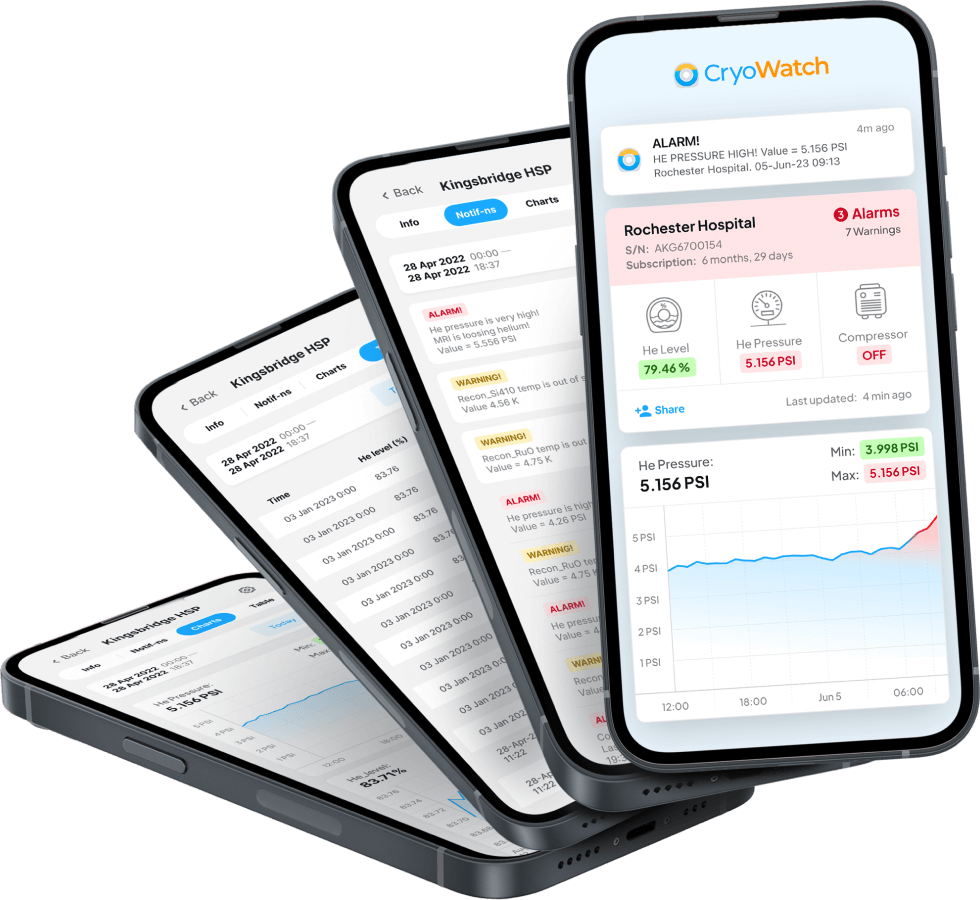
For the Cryowatch remote monitoring system, the generation of the magnet monitor plays an important role.
- Native Compatibility: Magmon 4 was designed from the ground up with deep digital data transmission in mind. This allows the Cryowatch system to receive a “cleaner” signal without interference.
- Predictive Analytics: Thanks to the high-precision data from Magmon 4, Cryowatch algorithms can build more accurate helium boil-off forecasts. You receive a notification not when “everything is failing,” but as soon as the parameters begin to deviate from the norm.
Comparison Table
| Feature | Magmon 3 | Magmon 4 |
| Main Architecture | Analog-Digital | Fully Digital |
| Precision (Helium Level) | Standard (1%) | High (0.1% – 0.5%) |
| Display Information | Basic (Numeric) | Advanced (Text Statuses) |
| Recommended Systems | Legacy Signa (HD, HDe) | Modern Signa (Explorer, Artist, Creator) |
| Cryowatch Connection | Via adapters | Native / Optimized |
The choice between these devices is usually dictated by the model of your MRI. However, if a clinic upgrades to Magmon 4 during a system modernization, it significantly increases the level of safety.
Combined with the Cryowatch service, the fourth-generation monitor transforms your scanner from a “black box” into a fully transparent system, where every liter of helium is under strict control.