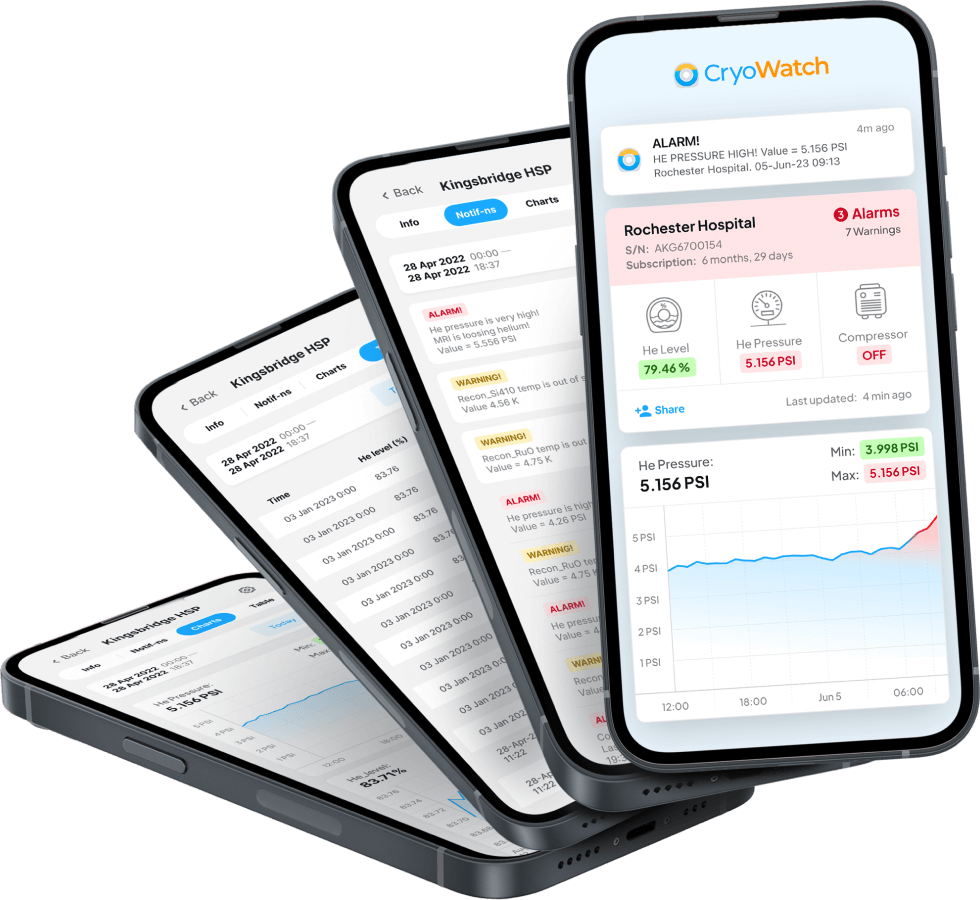
When we discuss the operational stability of a GE Healthcare MRI, the focus is usually on the magnet itself. However, experienced engineers know that the fate of expensive liquid helium and the continuity of patient schedules depend on an external unit: the chiller.
In this article, we will explore why the chiller remains a critical point of failure and how the compressor’s connection to the Magmon unit allows the Cryowatch system to see through potential issues before they become disasters.
Direct Connection: Magnet — Compressor — Chiller
A superconducting magnet requires extreme cold to operate. This is provided by the “cold head” (cryocooler), which is driven by a helium compressor. The compressor, in turn, generates a massive amount of heat that must be removed by the water (or coolant) supplied by the chiller.
In the architecture of GE Signa systems, there is deep integration:
- The Chiller supplies cooling water to the compressor.
- The Compressor is equipped with sensors that record not only its internal parameters but also the characteristics of the incoming water.
- The Magmon is connected to the compressor via an interface cable, receiving real-time data regarding water flow rate, water temperature, and the operating modes of the entire cooling chain.
Thus, the Magmon is not just a helium pressure gauge; it is a comprehensive diagnostic hub for the MRI’s life-support system.
Why is the Chiller a “Risk Point”?
Despite the high-tech nature of the scanner itself, the chiller operates in harsh conditions:
- Seasonal Loads: In summer, radiators get clogged with dust and pollen, causing a drop in flow rate or a spike in temperature.
- Mechanical Wear: Pump failures or refrigerant leaks within the chiller instantly change the parameters of the water entering the compressor.
- Automation Glitches: Chiller controller errors can lead to an abrupt shutdown of the cooling process.
How Monitoring Detects the Problem Before an Emergency
Because the Magmon relays compressor data, the Cryowatch service doesn’t just see a “failure event”—it sees the dynamics of system degradation:
- Flow Rate: If the chiller filters become clogged, the Magmon detects a decrease in flow. Cryowatch will send a notification to clean the system long before the compressor trips a “Low Flow” protection alarm.
- Water Temperature: A rise in water temperature at the compressor inlet is a clear sign that the chiller is struggling with the heat load.
- Operating Modes: Any anomalous compressor behavior caused by unstable chiller performance is immediately reflected in the monitoring logs.
Crucial Note: Without remote monitoring, clinic staff usually only learn about a problem when the red light flashes and the machine stops. Cryowatch, however, sees the “pre-symptomatic” state—when water parameters are still within tolerance but are showing a dangerous trend.
Summary: From Reactive to Predictive Service
The chiller is indeed the “weakest link,” but modern GE Healthcare systems provide all the tools necessary to control this threat. The Magmon unit collects data on water and temperature, and Cryowatch transforms this data stream into actionable alerts.
Don’t wait for a chiller to stop your business. Utilize your equipment’s capabilities to their full potential.