Many clinic owners believe that if their MRI scanner is connected to an Uninterruptible Power Supply (UPS), the system is completely safe. However, in practice, a UPS often only protects the console and the electronics, while the “power-hungry” component—the cooling system compressor—is left alone to face the harsh realities of the municipal power grid.
In this article, we will explore why unstable power is the primary enemy of your cryo system and how the Magmon unit helps you detect these issues before it’s too late.
Why Is the Compressor So Sensitive to the Grid?
The helium compressor in a GE Healthcare Signa system is a powerful electric motor operating under heavy load 24/7. To run reliably, it requires near-perfect electrical parameters.
What happens during power fluctuations:
- Voltage Drops (Brownouts): If the voltage drops, the current in the motor windings increases. This leads to overheating of the insulation. Over time, the insulation degrades, leading to short circuits and total compressor failure.
- Voltage Spikes: High-voltage pulses can instantly “fry” the compressor’s control board or destroy sensitive sensors.
- Phase Imbalance: If the load across phases is uneven, the motor begins to vibrate and overheat, drastically reducing the lifespan of its bearings.
How Magmon Records “Electrical” Issues
Because the compressor is directly interfaced with the Magmon, the magnet monitor essentially becomes an “oscilloscope” for your electrical grid.
- Indirect Signs: Magmon records sudden compressor shutdowns or transitions into “Error Mode.” If the logs show the compressor “tripping” at the same time every day (e.g., in the morning when the building’s elevators are most active), it is a clear sign of power issues.
- Thermal Response: Under unstable power, the efficiency of helium compression drops. Magmon then transmits anomalous temperature readings at the inlet/outlet, even if the chiller is performing perfectly.
Cryowatch: Your Expert on the “Electrical Trail”
The main problem with “bad electricity” is that it kills equipment slowly. You might not notice the issue for months until the compressor simply burns out.
The Cryowatch system changes the rules of the game:
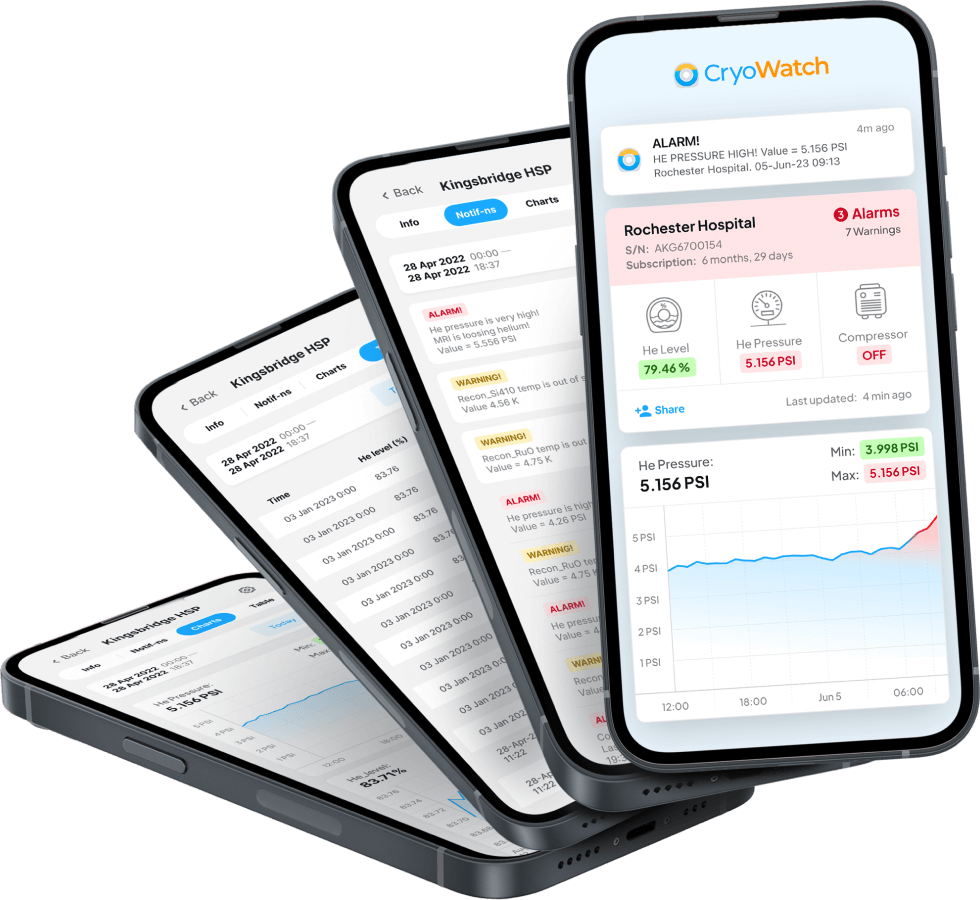
- Event Correlation: The system matches compressor performance data with the event log. If Cryowatch sees a series of “Warning: Compressor malfunction” notifications that coincide with flickering lights in the clinic, the engineer receives a clear directive: check the electrical panel.
- Protection Against “Silent Death”: We can see when a motor begins to operate in abnormal power modes, allowing us to recommend a stabilizer installation before the windings burn out.
- Incident History: When analyzing warranty claims, Cryowatch data helps prove whether the failure was caused by an external factor (the grid) or a manufacturing defect.
Summary: Don’t Skimp on Protection
Stable power is the “blood” of your cooling system. Remember that repairing or replacing a GE Signa compressor costs dozens of times more than a high-quality industrial voltage stabilizer.
With the Cryowatch system, you aren’t just watching helium pressure—you are monitoring the entire life-support chain of your MRI, protecting it from the invisible threats lurking in the power outlet.