Facility: Private Diagnostic Center.
Equipment: GE Healthcare Signa Explorer 1.5T MRI Scanner.
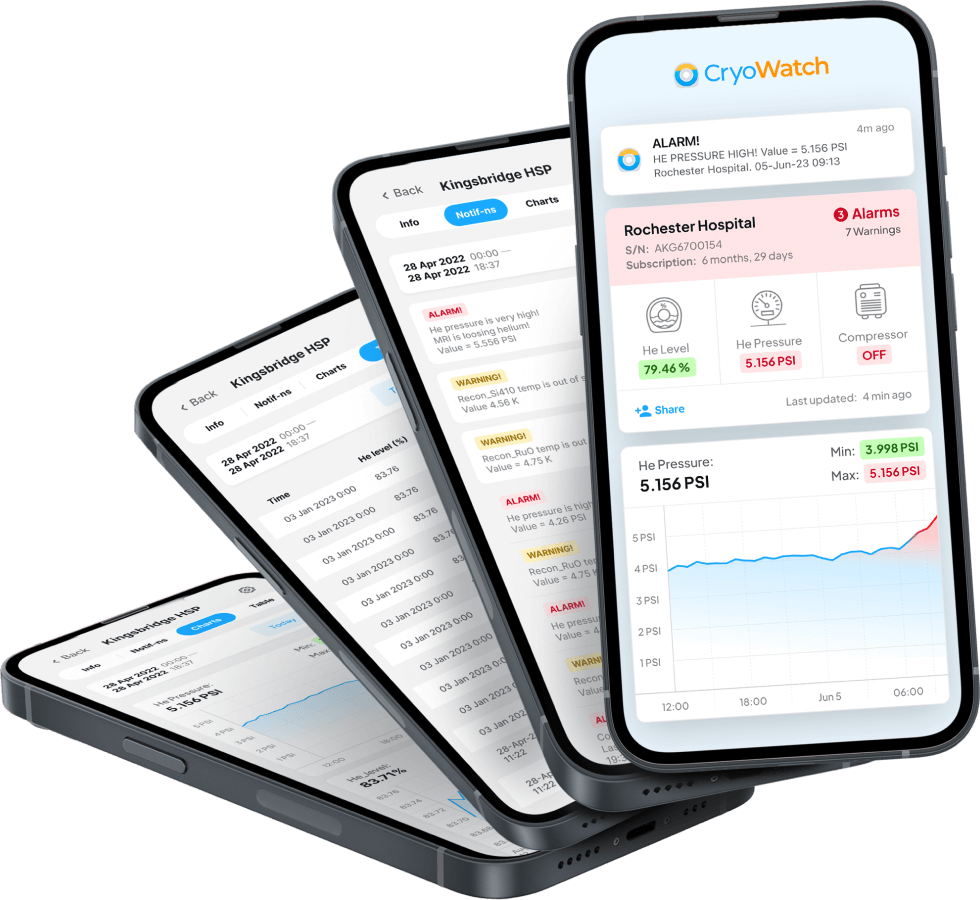
Control System: Magmon 4 unit + Cryowatch remote monitoring service.
Background
The events took place during the New Year holiday season. The clinic was closed for the holidays from December 31st to January 3rd. Only a security guard was on-site, who had no access to the MRI technical room and was not trained to check the status of the cryo system.
Incident Chronology
January 1st, 02:15 AM
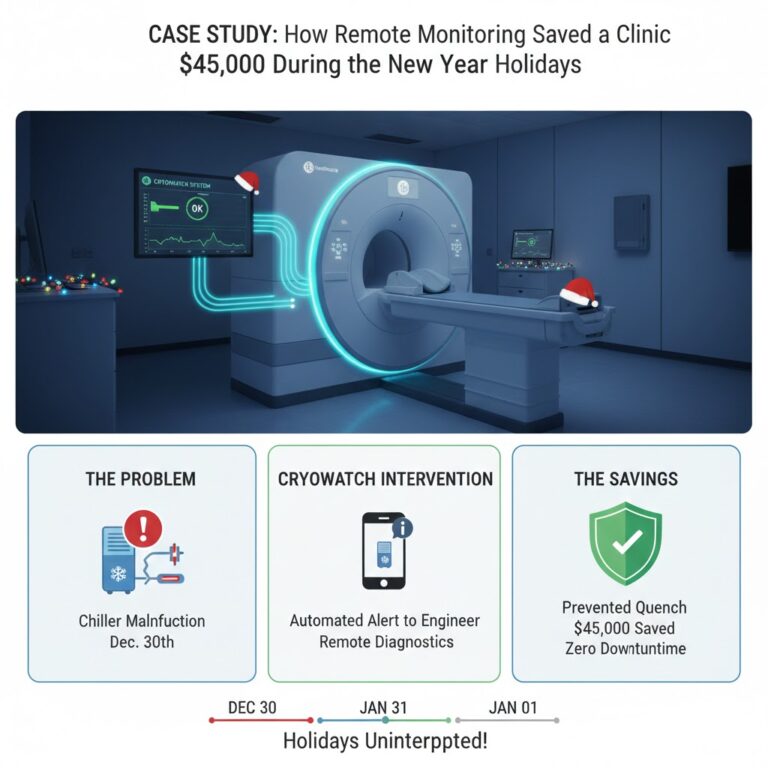
Due to a sudden power surge in the municipal grid, the external chiller (water cooling system) malfunctioned. The chiller stopped, cutting off the cooling water supply to the MRI compressor.
January 1st, 02:45 AM
Without cooling, the compressor began to overheat. The Cryowatch system, detecting a deviation in the equipment’s operating parameters, instantly sent the first alert: “Warning: Compressor malfunction.” This was the first signal that the magnet’s cooling system had stopped functioning normally.
January 1st, 03:00 AM
The cold head finally stopped. The helium inside the cryostat began to absorb heat rapidly, transitioning from liquid to gas. The Magmon 4 unit recorded a pressure rise above the critical threshold of 0.5 PSI.
The Role of Cryowatch
In normal circumstances, this situation would only have been discovered on the morning of January 4th when staff returned to work. By that time, the system would have guaranteed a quench—an emergency discharge of helium.
Thanks to timely notifications, the situation ended differently:
- 02:46 AM — First warning “Compressor malfunction” received via Viber.
- 03:01 AM — The system detected a critical signal from Magmon regarding pressure rise.
- 03:02 AM — The on-call service engineer received an emergency notification via Viber and email labeled: “CRITICAL: High Pressure / Compressor Offline.”
- 03:10 AM — The engineer connected remotely to the dashboard and confirmed that the compressor was down and pressure was rising at a rate threatening a quench within a few hours.
The Resolution
The engineer arrived at the clinic at 04:30 AM. He found the chiller locked in an error state, performed a manual reset, and restored the compressor’s operation. By 06:00 AM, the cryostat pressure stabilized and began to drop. The cryo system returned to its normal operating mode.
Economic Impact (Summary)
Let’s calculate what was avoided thanks to the combination of Magmon and Cryowatch:
| Expense Item | Without Monitoring (Quench) | With Cryowatch |
| Helium Loss (~600 liters) | $18,000 — $25,000 | $0 |
| Refill & Ramp-up Labor | $5,000 | $0 |
| Parts Replacement (Adsorber/Cold head) | $7,000 (potential risk) | $0 |
| Downtime (3 days of canceled slots) | $8,000 — $12,000 | $0 |
| Engineer Holiday Visit | $300 | $300 |
| TOTAL LOSSES: | ~$45,300 | ~$300 |
Conclusion
This case demonstrates that a modern MRI from GE Healthcare requires continuous oversight. The “Compressor malfunction” warning, received even before the pressure began to rise, gave the engineer the mission-critical time needed to save the expensive equipment. With Cryowatch, a major financial risk is transformed into a routine service task.